Request priority
AIplane uses low, medium and high request priority for chat and API model calls. Administrators configure a system default and priorities on existing gateway groups. The highest priority of a person's resolved groups applies; with no explicit group priority the system default applies. A token can inherit its owner's priority or override it, including lowering it for background work.
Strict priority dispatches executable high requests before medium and low. Within a class requests use arrival order. A request whose model or access cannot use a free backend does not block other executable requests. Running calls keep their slots until completion. Lower classes can time out under sustained higher-priority traffic. Queue deadlines and cancellation release waiting requests and any slot assigned to them.
Capacity retries share one priority-ordered dispatch pass per 250 ms polling interval, so each waiting request does not rescan the entire queue. A zero waiting budget still permits one admission attempt. Stopping a chat cancels its pending model or automatic-selector admission without waiting for GPU capacity; cancellation is checked every 50 ms while admission is pending.
Shared mechanisms
- The DB-backed gateway groups and RBAC resolver determine group membership.
- The existing tokens table stores the token override; token management remains owner-scoped for personal priority changes and administrator-scoped for unrestricted changes.
- The typed operator settings catalog stores the switch and system default.
UpstreamRegistry,PoolAccess, aliases, fallback routing and prefix affinity continue to select authorized models and backends.route_or_waitowns waiting, with one registry-owned priority queue, andAcquiredowns each running slot.- Backend identification supplies reported scheduling capabilities. The existing backend editor stores automatic, gateway-only or manual parameter mappings.
- One priority mapping translates the effective class at the final dispatch boundary, including tool rounds, retries and fallback backends.
PrioritySelectand the existing token creation dialog and card editors provide personal and administrator priority controls.- The RBAC resolver supplies the inherited priority and administrator rights; the server checks the permitted ceiling before token creation or a personal priority update.
- Fluent catalogs supply labels and errors in all six UI languages.
Administration
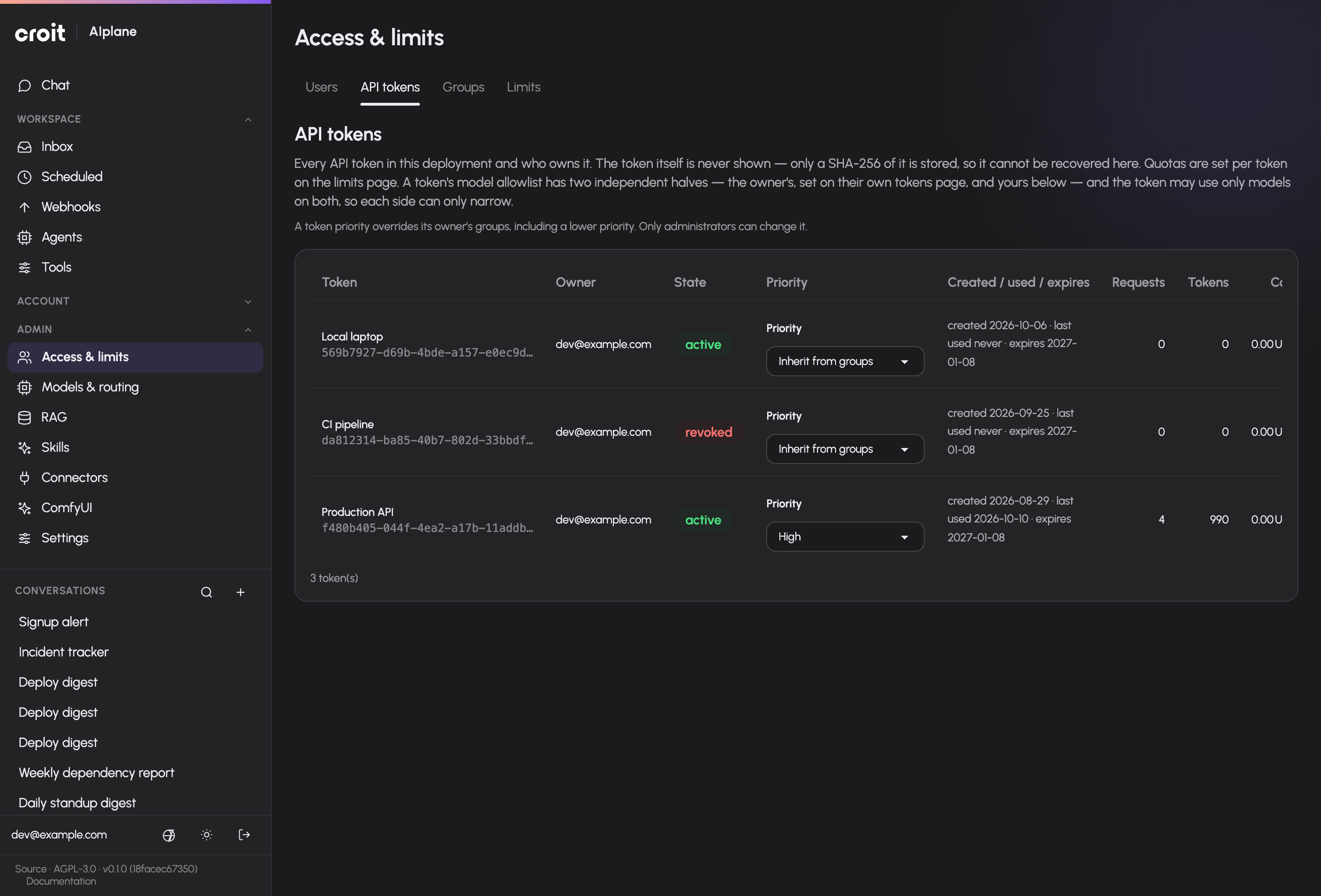
Enable request prioritization under Administration → Settings → Access → Gateway (gateway.priority_enabled, disabled by default) and choose the system default. Edit a
group's priority under Administration → Access → Groups. Under Tokens, choose
inherit, low, medium or high for any application making API requests. Owners choose priority during creation under Settings → Tokens and edit it through the Priority tile. Owners can choose values up to their inherited user priority or restore inheritance. Administrators can choose any value. The personal API checks this ceiling against current groups on every save, even when prioritization is disabled.
Tokens without an override and browser chat inherit their owner's groups.
Token save failures restore the previous selection and clear earlier success messages. Backend save errors receive keyboard focus and scroll into view; priority errors use the administrator's selected UI language.
Backend priority defaults to automatic. Automatic forwarding requires reported enabled scheduling and a known priority direction. Gateway-only mode sends no backend priority. Manual mode explicitly maps the three classes to a top-level integer parameter; it overrides detection. Parameter names cannot replace model, messages, tools, streaming or generation controls. Client-supplied priority is replaced or removed; it cannot elevate the authenticated caller.
vLLM requires --scheduling-policy priority; lower integers run first. SGLang
requires --enable-priority-scheduling with --schedule-policy fcfs or lof; larger integers run first unless
--schedule-low-priority-values-first is set. Identifying the software alone
does not prove these flags are enabled. Other backends still use gateway
priority, and receive a parameter only when configured explicitly.
The gateway queue and slot counters belong to one AIplane process. Multiple instances do not share this admission queue. Backend scheduling applies to requests received by that backend across callers when its scheduler is enabled. Forwarding priority does not guarantee a latency bound or reserve GPU capacity.
API and configuration
PUT /api/v0/admin/groups accepts priority: "low" | "medium" | "high" | null.
PUT /api/v0/admin/tokens/{id}/priority accepts {"priority":"high"};
null restores inheritance. Both require an administrator session.
POST /api/v0/tokens accepts an optional priority: "low" | "medium" | "high" | null.
Omitting it or sending null inherits the owner's groups. PUT /api/v0/tokens/{id}/priority
accepts the same priority field and requires a session belonging to the token owner.
The server returns 403 for a value above the owner's current inherited priority,
unless the owner is an administrator, and 404 for missing or foreign tokens.
Invalid priority values return 400. Rejected saves leave the token unchanged.
GET /api/v0/tokens/details includes each token's saved priority, the caller's
owner_priority and max_priority, and priority_enabled.
Client-supplied priority in model request bodies cannot elevate the caller.
PUT /api/v0/admin/backends accepts priority alongside the existing backend
fields. Save the complete editor and apply topology changes. Modes:
{"mode":"auto"}
{"mode":"gateway"}
{"mode":"custom","mapping":{"field":"priority","low":1,"medium":0,"high":-1}}
The last example is the vLLM mapping. Its scheduler flag must be configured in
its container command; AIplane does not change model-server startup arguments.
SGLang automatic mode requires /server_info to report the enabled flag,
fcfs or lof, and schedule_low_priority_values_first. Missing fields leave
forwarding disabled. vLLM, Ollama, llama.cpp and generic endpoints need manual
mapping for forwarding; they always use the gateway queue when prioritization
is enabled. Gateway-only works without any model-server priority support.
The gateway settings are saved through POST /api/v0/admin/settings. Existing
gateway.upstream_wait_secs bounds slot waiting (120 seconds by default).
Set each backend's maximum in-flight requests to suit its actual serving
capacity: a gateway cannot reorder requests already admitted to a server that
ignores priority. A running low-priority request is not interrupted by AIplane.
Prefix affinity selects replicas within the scheduling decision, preserving
prompt-cache locality where capacity permits. Priority grants neither model
access nor additional usage allowance.
Backend references: vLLM request protocol and SGLang scheduling policy.
Documentation build: 2610.1.108 · commit b774e1f9e2c2